Asian American Federation — Mental Health Resource Platform
Mental health support remains heavily stigmatized across many Asian communities, leaving providers without centralized, culturally relevant tools to support the people they serve. The Asian American Federation wanted to create an MVP mental health resource hub specifically for providers working within Asian diaspora communities. The challenge was to organize fragmented educational materials into a scalable and accessible experience while operating within limited nonprofit resources. I led the UX direction for the Provider’s Corner experience, helping transform scattered mental health resources into a more structured, actionable, and provider-centered platform. Unlike the later expanded concept vision, this project focused on designing a practical MVP that could realistically support provider workflows while laying the groundwork for future scaling.

What we set out to do
The primary goal was to design a lightweight MVP that centralized mental health resources for providers into a single, accessible experience.
The platform needed to help providers:
- Find relevant educational resources quickly
- Better support clients and families
- Access culturally relevant mental health information
- Share translated resources more easily
The experience also needed to remain simple enough for future scaling and nonprofit maintenance.
What changed
The project operated under several key constraints:
- Limited nonprofit resources and staffing
- No fully established content system
- Existing materials spread across PDFs and static webpages
- Ambiguity around primary users early in the project
- Need to support multilingual accessibility for Asian diaspora communities
Additionally, many mental health conversations required careful cultural framing due to stigma and generational sensitivities surrounding emotional health.
What limited us
The project operated under several key constraints:
- Limited nonprofit resources and staffing
- No fully established content system
- Existing materials spread across PDFs and static webpages
- Ambiguity around primary users early in the project
- Need to support multilingual accessibility for Asian diaspora communities
Additionally, many mental health conversations required careful cultural framing due to stigma and generational sensitivities surrounding emotional health.
What was broken
Fragmented Information Architecture
Resources were scattered across disconnected webpages, PDFs, and external documents without a cohesive organizational system.

Lack of Contextual Guidance
Many resources lacked summaries or explanations, forcing providers to manually review documents before determining usefulness.
Accessibility Gaps
Existing materials did not adequately support multilingual access or flexible download experiences for diverse Asian communities.
Audience Misalignment Early On
Initially, I explored more community-facing solutions based on provider interviews discussing client struggles. However, stakeholders later clarified that the MVP needed to remain focused on provider workflows due to scope and resource limitations.
How I solved it
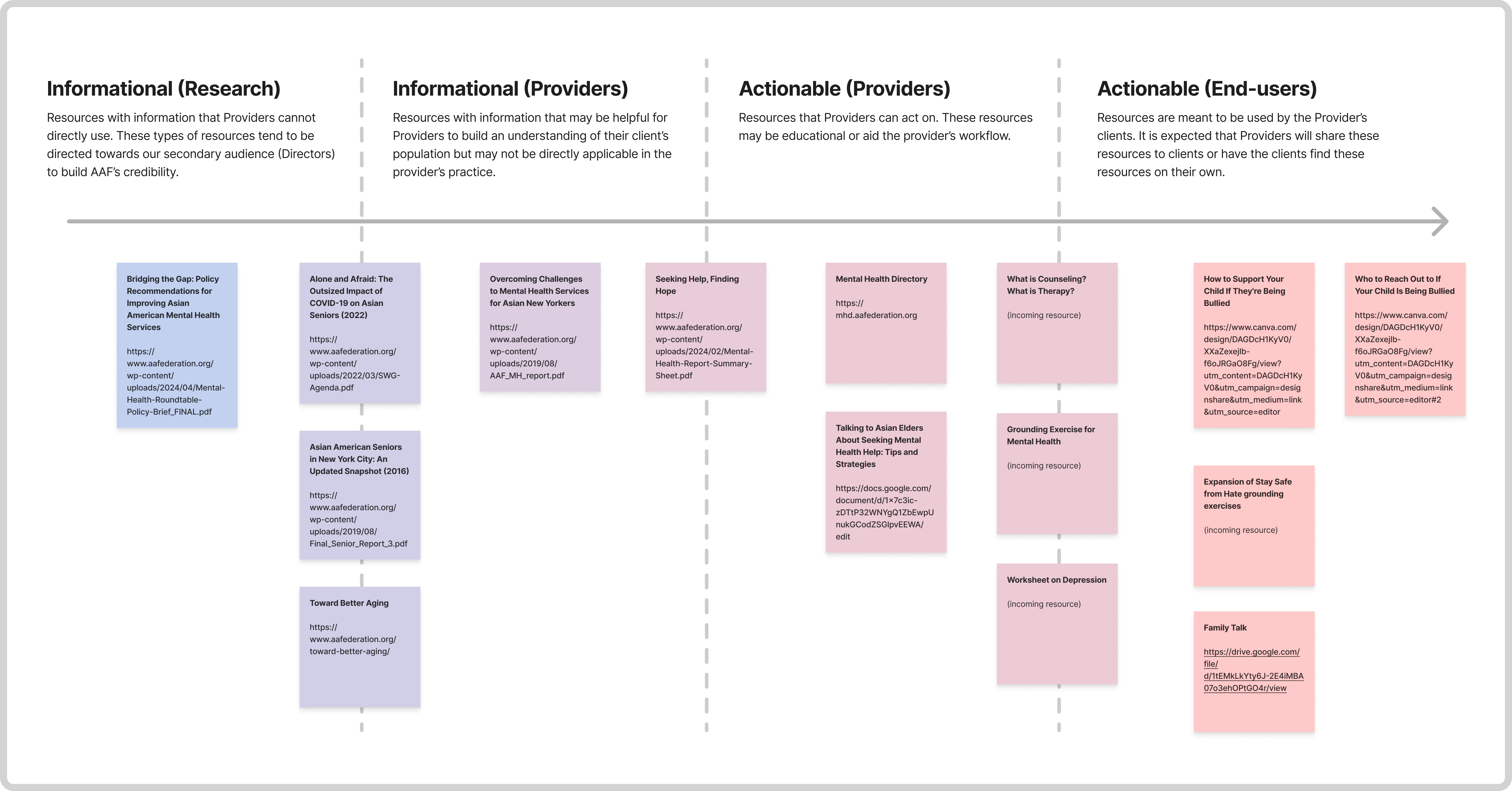
I conducted content inventory analysis and affinity mapping exercises to reorganize the nonprofit’s mental health resources into clearer thematic groupings.
The content was ultimately structured around two core provider questions:
I conducted content inventory analysis and affinity mapping exercises to reorganize the nonprofit’s mental health resources into clearer thematic groupings.
The content was ultimately structured around two core provider questions:
1. What resources can help providers?
Focused on educational and informational support including:
- Mental health education
- Bullying support
- Guidance for supporting seniors
- Research-based resources


2. How can providers support clients?
Focused on actionable provider workflows including:
- Finding culturally relevant resources
- Learning how to communicate with clients
- Understanding Asian community-specific mental health concerns
This framework became the foundation of the MVP architecture.

Designing for Simplicity & Scalability
Resource Page Redesign
One of the biggest UX opportunities was improving how resource documents were presented.
Previously, pages displayed little more than:
- A PDF image preview
- Minimal descriptions
- Download links
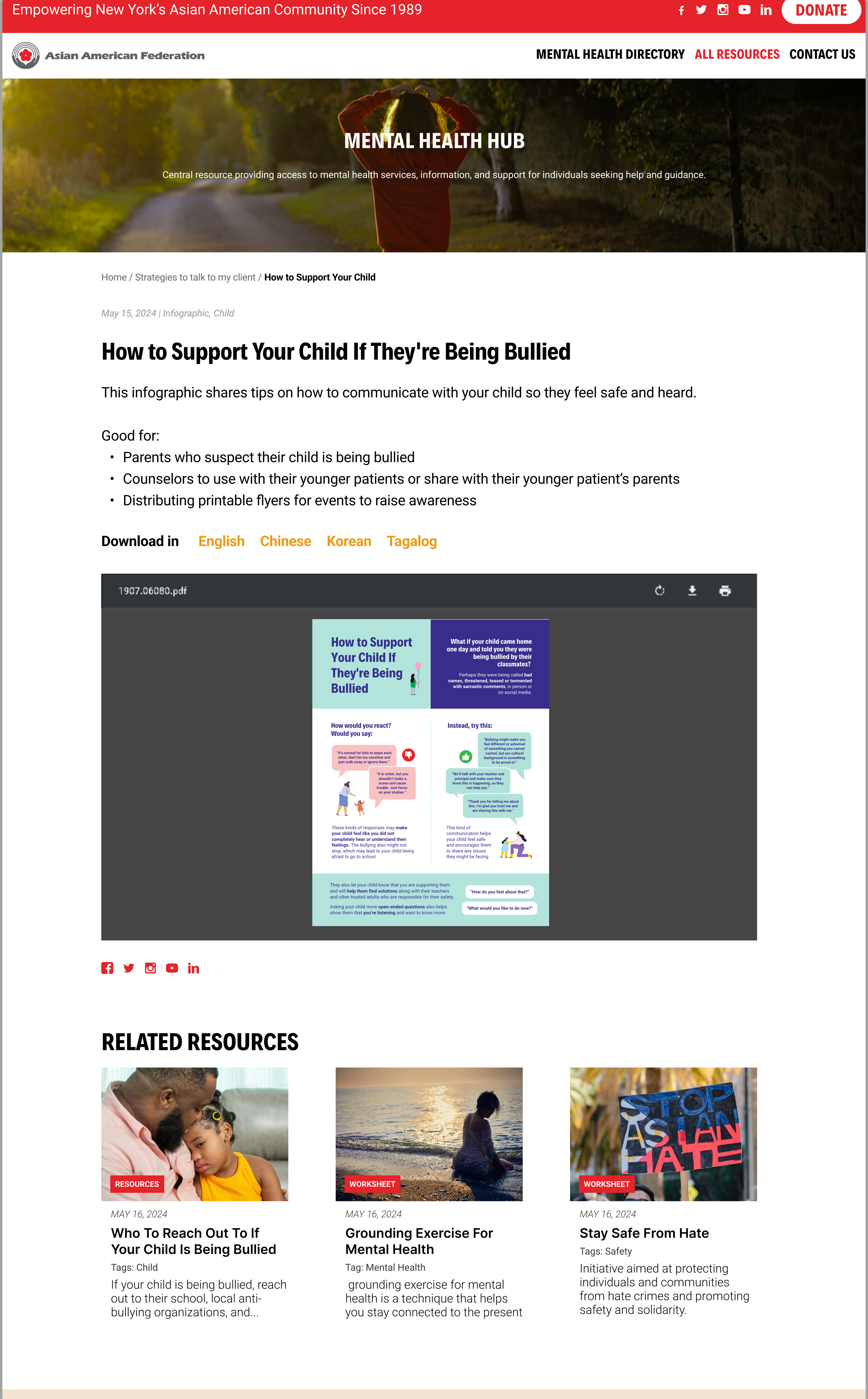
I redesigned the experience to include:
- Resource summaries
- Actionable highlights
- Downloadable translations
- Contextual guidance explaining how providers could use each resource
This shifted the experience from static document storage into a more supportive educational system.
Multilingual Accessibility
Because many users within Asian diaspora communities may not speak English as a first language, I designed scalable translation patterns that allowed providers and users to preview, switch, and download resources in multiple languages.
The goal was to ensure the platform could expand accessibility over time without requiring a full redesign.

Provider-Centered Navigation
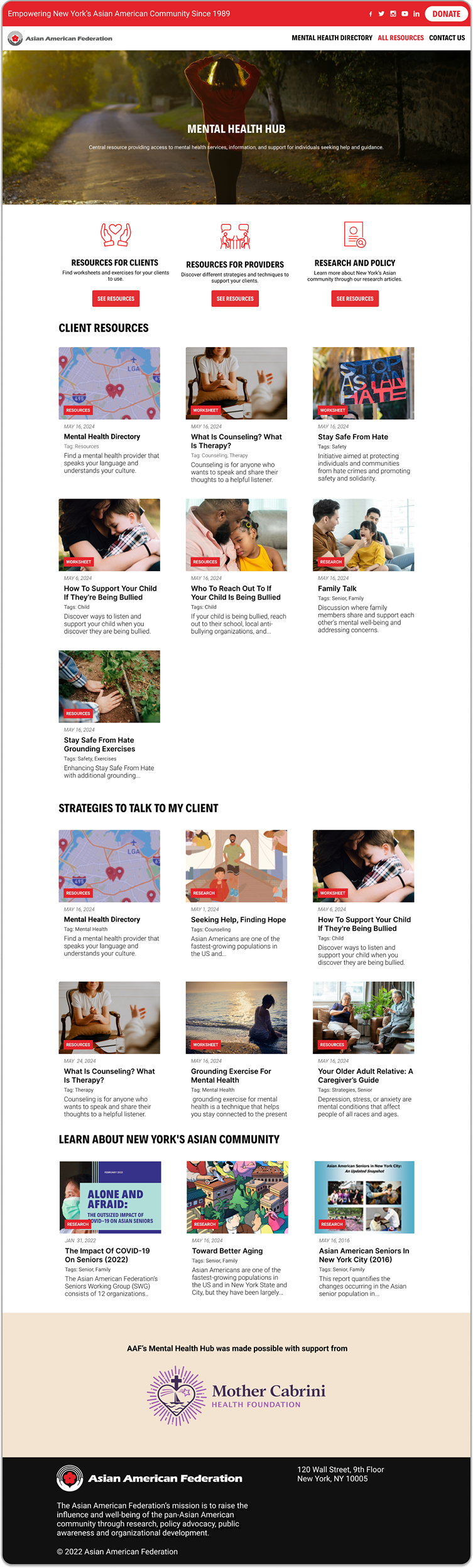
Instead of designing around broad community browsing, I restructured the information architecture around provider mental models and workflows.
This helped simplify discovery and reduced friction when searching for specific educational materials or support tools.
What it became
The final MVP direction aligned more closely with the organization’s operational capacity while still supporting long-term scalability goals.
The redesigned structure gave the Asian American Federation a clearer framework for organizing future mental health resources and supporting providers more effectively.
The project also established foundational UX patterns that could later evolve into a broader community-facing mental health ecosystem.
Most importantly, the redesign helped transform fragmented information into a more approachable and culturally sensitive support experience.
What I learned
This project taught me the importance of balancing ideal product vision with operational reality.
One of the biggest lessons was recognizing how quickly product direction can shift when stakeholder expectations and user assumptions are not fully aligned early in the process.
Initially, I designed portions of the experience around community members because provider interviews heavily emphasized client struggles. After stakeholder clarification, I had to strategically pivot the MVP back toward provider-centered workflows while preserving future scalability.
That pivot ultimately strengthened the product because it forced me to prioritize simplicity, maintainability, and realistic implementation over feature expansion.
The experience also reinforced how impactful thoughtful UX can be within nonprofit and social impact spaces — especially when designing for underserved communities navigating stigma, language barriers, and accessibility challenges.
Let's figure out
something
great together ❖
Whether you've got a role, a project, or just want to talk design — I'm genuinely happy to hear from you. No pressure, no pitch.